
What to do immediately after chipping a tooth?
Running your tongue over a jagged edge where your tooth used to be smooth is one of those small moments that sends a jolt of panic through your chest. One second everything was fine; the next, you were wondering whether you need to rush to A&E or whether this is something that can wait until Monday. The good news is that most chipped teeth are entirely fixable, and understanding how chipped teeth are repaired, as well as what to do in the first hour, can protect the tooth and make your dentist's job considerably easier.
This article is written by the clinical team at Wigmore Smiles & Aesthetics in Luton, and it covers everything you need to know: immediate first aid, how to judge urgency honestly, and the main repair options available today, from composite bonding to porcelain veneers. We have also included typical UK private practice costs for 2026, including NHS band charges, so you walk into any dental appointment already informed and confident rather than anxious about surprises.
What to do in the first few minutes
Rinsing, soothing, and protecting the tooth
Your first priority is simple: rinse your mouth gently with lukewarm water. This clears any debris from around the chip without putting pressure on the damaged area. If there is bleeding from the gum, fold a clean piece of gauze and hold it against the site with steady, gentle pressure for around ten to fifteen minutes. If swelling appears on your cheek or lip, apply a cold compress to the outside of your face. Never place ice directly on the tooth itself, as the sudden temperature change can aggravate an already sensitive nerve.

Once things are calm, avoid eating on the damaged side and steer clear of very hot, cold, or sweet foods. If there is a sharp edge catching your tongue or cheek, a small piece of dental wax or even sugar-free gum pressed over it will provide temporary relief. You can take an over-the-counter pain reliever such as ibuprofen if you need it, taken as directed on the packet.
Saving the fragment and what not to do
If a visible piece of tooth has broken away, do not throw it out. Place it in a small container of milk or, if that is not available, your own saliva. There is a chance your dentist can reattach it directly, and even if they cannot, having the fragment helps them assess the extent of the break. Do not rinse it under the tap, scrub it, or let it dry out.
There are a few things that feel logical but will make matters worse. Avoid filing the sharp edge down yourself, applying household glue to the tooth, or placing aspirin directly against the gum. These approaches can cause chemical damage to the tissue and complicate the repair. Similarly, resist the temptation to poke or prod the area. The less interference before your dental appointment, the better.
How quickly do you need to see a dentist?
Chip severity and how urgency changes with it
Not every chipped tooth is a dental emergency, but every chip deserves professional assessment. A small enamel chip with no pain, no sensitivity, no looseness, and no visible damage below the surface can usually wait for a routine appointment within a few days. The edge may need smoothing, and the tooth should be checked for any hairline cracks not visible to the naked eye, but you are not in immediate danger.
A moderate chip is a different matter. If you have noticeable sensitivity to temperature, a sharp edge causing discomfort, or pain when you bite down, contact your dentist within 24 to 48 hours. This level of damage often means the dentine layer beneath the enamel has been exposed, which requires prompt attention to prevent further deterioration. At this stage, the goal of treatment is to protect what remains healthy rather than manage a full crisis.
Warning signs that mean same-day or emergency care
Seek a same-day appointment if you notice any of the following: a visible pink or red spot inside the broken tooth, severe or persistent pain, bleeding from the tooth itself rather than the surrounding gum, or marked sensitivity to temperature that lingers for more than a few seconds. These signs suggest the pulp, which contains the nerve and blood supply, may be involved. A deep fracture following a significant impact also warrants urgent assessment even if you feel surprisingly little pain, as the root and supporting bone may have been affected.

Go directly to A&E if you experience uncontrolled bleeding that will not stop, rapidly increasing facial swelling, difficulty breathing or swallowing, a suspected jaw fracture, or any loss of consciousness after the injury. These are medical emergencies, and a dental appointment is not the right first step in those situations.
How are chipped teeth repaired: the main options
Composite bonding for minor chips
Composite bonding is the most common and conservative way to repair a chipped tooth, particularly for small-to-moderate chips on front teeth. The dentist lightly etches the tooth surface, applies tooth-coloured resin in fine layers, and shapes it to match the natural contour of the tooth. Each layer is then hardened with a curing light. The final step is a thorough polish to a smooth finish. For minor cases, no drilling is required, and the whole appointment typically takes between 30 and 60 minutes from start to finish.
In terms of cost, private composite bonding tooth repair typically runs from £100 to £450 per tooth across UK practices in 2026, with most straightforward front tooth chips falling in the £200 to £350 range. On the NHS, this type of repair falls under Band 2, which costs £76.60 in England from April 2026. Longevity is honest rather than dramatic: composite bonding generally lasts five to seven years. It can stain with heavy tea, coffee, and red wine consumption, and may chip again under heavy biting forces. That said, it can often be polished, touched up, or repaired without starting from scratch.
Dental crowns for more significant damage
When a large portion of the tooth has broken away, when the tooth is significantly weakened, or when root canal treatment has been carried out, a crown becomes the appropriate solution. A crown encases the entire visible portion of the tooth above the gum line, restoring both strength and appearance. Private costs range from £500 to £1,500 per tooth based on typical UK private practice pricing in 2026; if root canal treatment is needed first, the combined cost can reach £850 to £2,500 depending on the tooth involved and the materials used. On the NHS, crowns fall under Band 3, currently £332.10, when they are clinically necessary.
Understanding the difference between a crown and a veneer is important when deciding on treatment. A crown covers the whole tooth and is used when structural integrity is the primary concern. A veneer covers only the front surface and is chosen when the tooth is still fundamentally sound but the chip has affected its appearance. Your dentist's assessment will determine which is clinically appropriate for your situation. NHS treatment will cover a crown where clinically justified, though purely cosmetic improvements are generally considered private.
Can veneers fix a chipped front tooth?
When a veneer is the smarter long-term choice
For chipped front teeth where appearance and symmetry matter most, a dental veneer deserves serious consideration alongside bonding. A veneer is a thin shell of porcelain or composite material that is bonded to the front surface of the tooth, restoring its shape, colour, and natural-looking finish. Veneers work particularly well when the chip affects the biting edge or corner of an upper front tooth, when the surrounding teeth would benefit from a more uniform look, or when the patient wants a result that is more durable and stain-resistant than composite bonding can offer over the long term.

For a veneer to be suitable, sufficient healthy tooth structure must remain, and the tooth should be free from active decay or untreated nerve damage. Your dentist will assess this during the consultation and will be straightforward with you about whether a veneer is genuinely the right fit or whether another option would serve you better.
Porcelain vs composite veneers: understanding the difference
Composite veneers are applied directly at the chairside, require no laboratory work, and are quicker and more affordable. In the UK, they typically cost between £150 and £400 privately and last around five to seven years, similar to composite bonding. Porcelain veneers, by contrast, are crafted in a dental laboratory, involve a small amount of tooth preparation, and cost between £500 and £1,400 privately across the UK. In Luton, you can expect to pay in the region of £950 per tooth for ceramic veneers at a well-equipped private practice.
Porcelain veneers are considerably more stain-resistant than composite alternatives and can last fifteen to twenty years with good care. That longevity makes them the stronger long-term investment for a front tooth you use and see every single day. It is worth noting that veneers are generally a private treatment and are not routinely available on the NHS unless there is a specific clinical justification beyond cosmetics.
Cases where veneers are not the right fit
Veneers are not suitable for every chip. If the fracture extends below the gum line, if the tooth has active decay or nerve damage that has not yet been treated, or if there is insufficient healthy enamel remaining for the veneer to bond securely, a veneer would not be the right choice. Patients who grind heavily without a protective nightguard are also at higher risk of veneer failure. In these cases, a crown or another restoration will protect the tooth better, and your dentist's assessment will guide the decision.
Veneers vs composite bonding: making the right choice
Composite bonding is faster, requires no tooth preparation for minor chips, and is reversible: it can be polished, repaired, or removed without affecting the underlying tooth. Its main vulnerabilities are staining and susceptibility to chipping under heavy forces. Porcelain veneers are more robust and highly stain-resistant, delivering a polished, symmetrical result that bonding cannot fully replicate. The trade-off is that they require removing a small amount of the tooth's front surface, making the process irreversible.
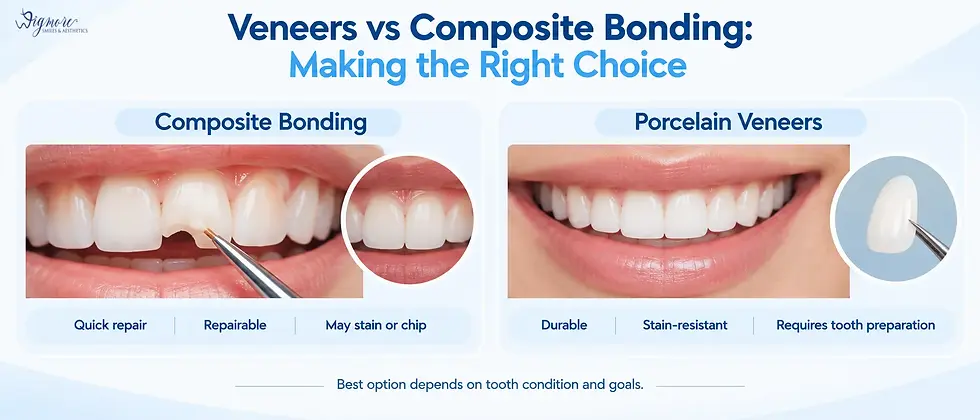
Thinking about value over time rather than upfront cost helps clarify the decision. Composite bonding at £200 to £350 may need replacing two or three times over the same period that a porcelain veneer lasts. Over fifteen years, the cumulative costs can be very comparable. For patients investing in a front tooth they show every time they smile, porcelain often represents the better value over time. At Wigmore Smiles & Aesthetics, we offer flexible 0% finance options, which means the higher upfront cost of porcelain need not be a barrier to getting the result that will actually last.
Restoring your smile at Wigmore Smiles & Aesthetics in Luton
What to expect at a consultation
An initial assessment at Wigmore Smiles & Aesthetics covers the full picture: the extent of the chip, the health of the tooth and surrounding gum tissue, your bite, and which repair options are clinically appropriate for your specific situation. Where helpful, we use digital imaging or our iTero 3D scanner to plan treatment precisely and give you a clear sense of the expected result before anything is done. Every cost is explained clearly before treatment begins, so there are no surprises when you arrive for your appointment.
Booking your chipped tooth assessment
Whether you chipped a tooth this morning or have been quietly putting off addressing one for months, our team is ready to help you find the right solution. That might be same-day composite bonding, a porcelain veneer planned over two appointments, or a different restoration depending on what the tooth requires. Get in touch with our team in Luton to book a dental assessment online or by phone. Emergency appointments are available for more urgent cases, so do not hesitate to call on the day if you are in significant pain or concerned about the severity of your chip.
Pulling it all together
How are chipped teeth repaired, a summary
Chipping a tooth is more common than most people realise, and modern dentistry has excellent options for restoring both function and appearance regardless of severity. The essentials are these: act quickly with first aid, assess your urgency honestly based on your symptoms, and get a professional evaluation before committing to any treatment. How chipped teeth are repaired will depend on the size and location of the damage, from a straightforward composite bonding appointment for a minor chip through to a porcelain veneer or crown for more significant breaks.
For front tooth chips where aesthetics matter, porcelain veneers offer the most durable and natural-looking result available. Composite bonding remains a practical, affordable, and effective alternative for smaller chips where the cosmetic bar is a little lower. Either way, the repair options available for chipped teeth today are far more sophisticated than many patients expect, and the process is considerably less daunting than it sounds.
If you are based in or around Luton and are ready to explore repairing a chipped tooth or dental veneers, Wigmore Smiles & Aesthetics is here to guide you through every step, from that first nervous call to a finished result you are genuinely pleased with.


Comments