
Different types of teeth straightening treatments available
If you've spent any time researching treatments for straightening teeth, you'll know the information quickly becomes overwhelming. More orthodontic options are available now than in previous decades, and the differences between them genuinely matter: how visible they are during treatment, how long they take, what dental problems they can actually fix, and what they cost privately in the UK. At Wigmore Smiles & Aesthetics in Luton, "which treatment is right for me?" is one of the most common questions we hear during consultations. This article walks through each major orthodontic option in plain terms, so you can walk into your first appointment already knowing the right questions to ask.
There is no single best treatment for everyone. The right choice depends on the type and severity of your dental issue, your lifestyle, and your budget. What follows is a plain-English guide to help you weigh up your options before making any decisions.
Treatments for straightening teeth: the main options explained
Before comparing teeth straightening treatments side by side, it helps to have a clear picture of what actually exists. The main orthodontic options available privately in the UK fall into three broad categories: fixed braces bonded to the front of the teeth, fixed braces bonded to the back, and removable clear aligners.
Fixed metal braces: still the gold standard for complex cases
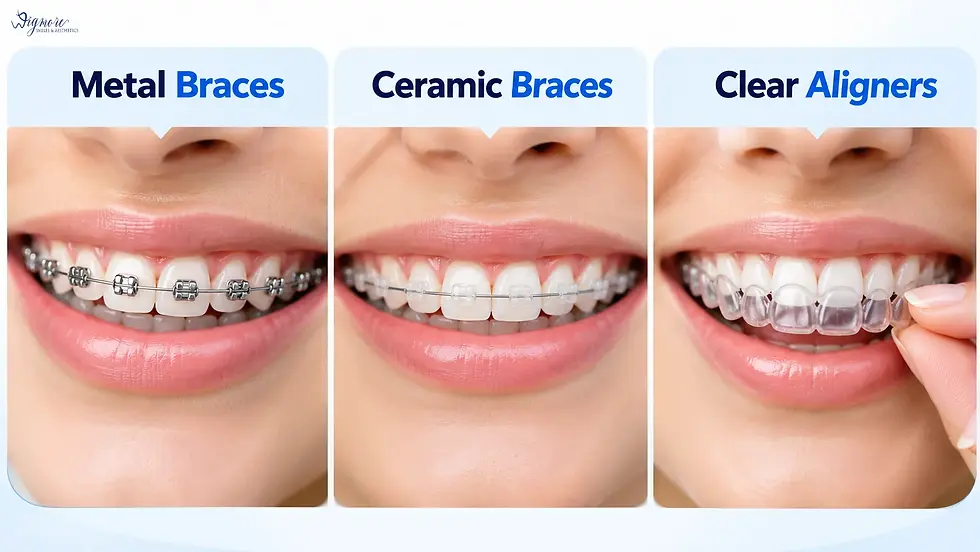
Traditional metal braces consist of brackets bonded directly to the front surface of each tooth, connected by a wire that is periodically adjusted to apply controlled pressure. They remain the most versatile option for complex tooth movements and are the most common NHS-funded treatment for eligible children and teenagers. For adults, however, treatment is almost always arranged privately, since NHS orthodontics for adults is reserved for very specific clinical circumstances.
Ceramic and tooth-coloured braces: less visible, still fixed
Ceramic braces use exactly the same mechanism as metal braces but with brackets made from tooth-coloured or clear materials, making them considerably less noticeable at a normal conversational distance. They do carry a slightly higher cost and a staining risk if you regularly consume coffee, tea, or red wine. Lingual braces take discretion further still: they attach to the back surface of the teeth, making them virtually invisible from the front. The trade-off is a higher price tag and a longer adjustment period, particularly for speech and tongue comfort in the early weeks.
Clear aligners: the removable, modern alternative
Clear aligners are custom-made, removable plastic trays that shift teeth gradually through a planned series of movements. Invisalign is the most clinically established brand in this category and is prescribed by GDC-registered dentists and orthodontists across the UK. Unlike at-home aligner services, Invisalign treatment in Luton is planned, monitored, and adjusted by a qualified clinician throughout the process. For patients exploring short-term cosmetic orthodontics, options such as Six Month Smiles, which use tooth-coloured brackets and wires to focus primarily on the visible front teeth, can also be worth discussing during a consultation.
How Invisalign works: the treatment process from scan to straight teeth
For many of our patients at Wigmore Smiles & Aesthetics, Invisalign is the option that genuinely changes how they feel about pursuing treatment. Understanding how the process actually works helps demystify it considerably.
From 3D scan to custom aligners
Treatment begins with a detailed digital scan of your teeth using an iTero intraoral scanner, which creates a precise 3D map of your dental arches without the need for messy putty impressions. From this scan, a bespoke series of aligners is fabricated, each one designed to move your teeth a small, controlled amount. Patients typically progress to a new set of aligners every one to two weeks, though clinicians may adjust this interval depending on the complexity of the case and how well the teeth are tracking.
Wearing aligners day to day: what compliance actually means
Aligners need to be worn for 20 to 22 hours per day, in line with Invisalign's clinical guidance, to achieve the movement your treatment plan requires. They are removed for eating, drinking anything other than water, and brushing, and they go straight back in after meals. Treatment duration ranges from around six months for simpler cases to 18 to 24 months for more involved ones, though these are typical estimates that depend on case complexity and how consistently aligners are worn. The outcome depends heavily on consistent wear, which is why compliance is discussed thoroughly before treatment begins.

Regular check-ins and progress reviews
Unlike at-home aligner services, Invisalign treatment through a dental practice involves regular in-person progress reviews. Your clinician checks that your teeth are tracking as planned and can adjust the treatment if something isn't moving as expected. This ongoing supervision is not a formality; it is a clinical safeguard that protects both your result and your oral health throughout the process.
Invisalign versus traditional braces: what actually matters in daily life
Appearance and social confidence
Invisalign aligners are virtually invisible at normal conversational distance, which is why so many adults who would never have considered metal braces in their twenties are now pursuing treatment in their thirties and forties. Metal braces are the most noticeable option; ceramic braces are a significant step up in discretion; lingual braces rival clear aligners for invisibility from the front but sit behind the teeth. For adults who feel self-conscious about wearing orthodontic appliances at work or socially, many find that clear aligners are their preferred choice for cosmetic reasons.
Comfort and what to expect from each option
All orthodontic treatments involve pressure and temporary soreness as teeth move; that is simply the nature of the process. Fixed braces add the challenge of bracket and wire irritation to the cheeks and lips, which can be managed with orthodontic wax but does require an adjustment period. Lingual braces frequently cause more pronounced tongue discomfort and a noticeable lisp during the first few weeks. Invisalign typically produces pressure-related soreness for the first day or two of each new tray, which settles quickly as your teeth adjust.
Oral hygiene: why removable aligners make a meaningful difference
With fixed braces, plaque accumulates around brackets and requires meticulous brushing and interdental cleaning at every stage of treatment to prevent gum inflammation and white-spot lesions on the enamel. With Invisalign, you remove your aligners entirely to brush and floss as normal, which makes maintaining good oral hygiene considerably more straightforward. The key caveat is that teeth must be cleaned before reinsertion; trapping food debris or sugary drinks under a tray is a fast route to enamel problems.
Which dental problems can Invisalign treat?
One of the most important questions to answer honestly is clinical suitability. Overpromising on what aligners can achieve doesn't serve anyone well, so what follows is a straightforward breakdown.
What Invisalign handles reliably
Clear aligners work well for mild to moderate crowding, gaps between teeth, and certain bite issues. Crowding of roughly 1 to 5 mm, mild spacing, and selected anterior crossbites are among the most predictable indications. Small rotations, particularly on front teeth, can also be addressed effectively, often with the help of small tooth-coloured attachments bonded to the teeth to give the aligner better grip and control.

When fixed braces offer greater clinical reliability
Severe crowding, cases requiring extractions, significant overbite or overjet, broad posterior crossbites, and large rotations of back teeth are generally better managed with fixed braces. The reason is that fixed appliances offer greater three-dimensional control over root movement, which aligners cannot always replicate with the same precision. A professional assessment using proper clinical records is the only reliable way to determine which approach suits your specific case; a decision based on photographs or self-taken impressions alone is not clinically sufficient.
UK costs and how long each teeth straightening treatment takes
Going into a consultation with a realistic sense of the figures means you can focus the conversation on what's right for you, rather than being caught off-guard by cost. Here is what to budget for each option.
Private pricing: what to budget for each option
Current private costs in the UK in 2026 are approximately as follows:
Metal braces: £1,500 to £4,000
Ceramic braces: £2,000 to £5,500
Lingual braces: £4,000 to £8,000
Invisalign or equivalent supervised clear aligners: £1,500 to £5,500, with most comprehensive cases in the £3,000 to £5,000 range
Treatment times vary from around six months for straightforward cases to 24 months for more involved ones. At Wigmore Smiles & Aesthetics, we offer finance options designed to spread the cost of private orthodontic treatment in a way that suits your monthly budget, please ask the team for full eligibility details and terms when you book your consultation.
NHS eligibility and at-home aligners: knowing the limits
NHS orthodontics is available primarily for children and teenagers with a clinically assessed need, scored using the Index of Orthodontic Treatment Need. Generally, a score of 4 or 5 is needed to qualify, and even then, waiting lists and regional availability vary considerably. Adults can rarely access NHS orthodontics for cosmetic reasons; the threshold for funding requires a substantial functional or clinical need, or hospital-level complexity.
At-home aligner services may appear attractive at £1,200 to £2,000, but the GDC and British Orthodontic Society are both clear on this point: orthodontic treatment should begin with a face-to-face clinical assessment by a named, GDC-registered clinician. Services that post aligners without meaningful professional assessment, a named responsible clinician, or appropriate supervision conflict with GDC and BOS guidance and carry recognised risks, including poor outcomes and, in some cases, permanent damage to dental health. The lower price tag carries a genuine clinical risk that is worth understanding before you proceed.
Keeping your smile straight after treatment
Why retainers are a permanent part of the result
After any orthodontic treatment, teeth want to drift back toward their original positions. This is not a flaw in the treatment; it is a natural consequence of the periodontal fibres and surrounding tissues adapting over time. The current clinical consensus is that retention should be considered indefinite, typically nighttime wear of a removable retainer, sometimes combined with a fixed bonded retainer placed behind the front teeth.

Long-term studies indicate that stopping retainer wear after just one to two years can still leave a significant relapse risk over the following decade, so the phrase "wear it for as long as you want straight teeth" is genuinely the most accurate advice available. The specific retainer type and schedule should be individualised by your treating clinician based on your case.
Ready to find out which treatment is right for you?
If you are based in Luton or the surrounding area and would like to explore your options properly, the best starting point is a consultation at Wigmore Smiles & Aesthetics. Our team uses digital 3D scanning to assess your teeth accurately and build a personalised treatment plan, so you can see what's possible before committing to anything. Our flexible finance options are designed to make the right treatment genuinely achievable, not just theoretically affordable. Get in touch with our team to book your consultation and find out which treatments for straightening teeth best suit your smile.
The right treatment starts with the right assessment
Orthodontic care has advanced considerably, and teeth straightening treatments are now genuinely varied: from metal braces that handle the most complex movements, to Invisalign clear aligners that have made discreet, comfortable treatment available to adults who would never have sat in the chair twenty years ago. The right option depends on the type and severity of your dental issue, your lifestyle, and your budget, and no article alone can make that determination for you.
What this guide can do is help you arrive at your first consultation better informed. You now understand the key differences between treatment types, what Invisalign can and cannot reliably treat, what UK private costs look like in 2026, and why professional supervision is non-negotiable regardless of which route you choose. The next step is a face-to-face assessment with a GDC-registered clinician who can take proper records, explain your options in the context of your specific teeth, and give you a treatment plan you can trust. Get in touch with the team at Wigmore Smiles & Aesthetics today to book yours.


Comments