
Best Toothache Medicine at Home: What Actually Works

When you need toothache medicine at home, ibuprofen or paracetamol is usually the most effective option, and a warm saltwater rinse alongside a cold compress is the safest supportive measure to use with them. These steps manage symptoms only; they cannot treat decay, a cracked tooth, or an abscess. The only thing that fixes the underlying cause is professional dental care.
Toothache is one of the most distressing types of pain, particularly when it strikes in the evening or over a weekend. At Wigmore Smiles & Aesthetics in Luton, we see patients regularly who have tried several home approaches before reaching us, and we understand how important it is to know what actually helps in those waiting hours. This article covers which medicines and remedies are worth using, how to use them safely, which approaches to avoid entirely, and how to recognise when the pain is telling you something no home remedy can fix.
Key takeaways
Best OTC medicine: Ibuprofen (200–400 mg with food, every 6–8 hours) is the strongest option for most healthy adults; paracetamol is the preferred alternative when ibuprofen is not suitable.
Combining both: Ibuprofen and paracetamol can be taken together or staggered, provided each stays within its own daily limit.
Safest home remedies: A warm saltwater rinse and an external cold compress are low-risk, broadly supported, and a sensible starting point for tooth pain relief at home.
Clove oil: Has genuine evidence for short-term numbing, but must be diluted and used sparingly.
Never place aspirin on the gum: This causes chemical burns to soft tissue and is one of the most common first-aid mistakes.
Seek urgent care: Swelling in the neck, difficulty breathing or swallowing, or a spreading infection require 999 or A&E, not a home remedy.
Best toothache medicine at home: OTC options that work
Ibuprofen and paracetamol: the two that consistently deliver results
Ibuprofen targets both pain and inflammation, which makes it the strongest over-the-counter option for most healthy adults. The standard OTC dose is 200–400 mg taken with food every 6–8 hours, not exceeding 1,200 mg in any 24-hour period. It is not suitable for everyone: avoid it if you have a stomach ulcer, kidney disease, uncontrolled high blood pressure, an NSAID allergy, or if you are pregnant, particularly from 20 weeks onward.

Paracetamol is the right choice when ibuprofen is not appropriate. The adult dose is 500–1,000 mg every 6 hours, following the product's stated daily maximum, typically 4,000 mg for most adults. Lower limits apply if you have liver disease, weigh under 50 kg, or regularly drink alcohol. Paracetamol does not reduce swelling, but it reliably reduces pain.
Staggering or combining both medicines is acceptable, provided each stays within its own safe daily limit. There is no major direct interaction between them, and taking them at different intervals can provide more consistent relief than relying on one alone. Always keep a note of the time and dose taken, so you do not accidentally exceed either limit.
Benzocaine gels: temporary numbing with one serious caveat
Topical analgesic gels containing benzocaine are a useful short-term add-on for surface discomfort around the tooth or gum. Apply a small amount to the affected area with a clean fingertip or cotton swab, following the label directions exactly. The numbing sensation is temporary and does nothing for the underlying cause, but it can provide meaningful relief while you arrange care.
One warning is worth taking seriously: benzocaine can, in rare cases, cause methemoglobinemia, a condition where the blood cannot carry oxygen properly. Stop use immediately and seek urgent help if lips or skin take on a blue or grey colour, breathing becomes difficult, or you feel unusual weakness or a rapid heartbeat. Benzocaine gels must never be used in children under two years old.
Toothache medicine at home, safe home remedies and cautions
The two home toothache remedies most worth trying first
A warm saltwater rinse is the safest and most broadly supported home treatment for dental pain. Dissolve half a teaspoon of salt in a glass of warm water, swish gently for around 30 seconds, and spit. It does not treat the tooth, but it reduces oral inflammation, clears debris, and can take the edge off soreness. Repeat a few times a day while you wait to be seen.

For facial swelling, a cold compress applied to the outside of the cheek is standard first-aid practice. Wrap an ice pack in a cloth and hold it against the face for 10 to 15 minutes at a time, with breaks in between. Do not apply ice directly to the skin. Neither remedy addresses what is causing the pain, but both are low-risk and genuinely helpful as a bridge to professional care.
Clove oil: the most evidence-backed natural option
Clove oil contains eugenol, a compound with genuine local anaesthetic and anti-inflammatory properties. Dental professionals use eugenol-based preparations routinely, and clinical trials have found clove gel to reduce oral pain comparably to benzocaine in some settings. That makes it the most credible natural option if you are looking for something beyond paracetamol while you wait for an appointment.
To use it safely, dilute a small amount in a carrier oil such as olive or coconut oil, then dab it carefully onto the tooth or affected gum with a cotton swab. Do not apply it undiluted, do not soak the surrounding tissue, and do not use it repeatedly throughout the day. Concentrated clove oil can burn soft tissue and irritate an open cavity, which makes careful application essential.
Hydrogen peroxide, garlic, and peppermint: what the evidence actually says
A diluted 3% hydrogen peroxide rinse (mixed 1:1 with water) has reasonable evidence for reducing oral bacteria but limited evidence for reducing tooth pain itself. If you use it, swish briefly and spit thoroughly; never swallow it, and do not use it in children or anyone who cannot reliably spit.
Raw garlic placed on the gum is best avoided. It can chemically burn oral tissue, and any antibacterial effects observed in laboratory settings have not been shown to translate into clinical pain relief. Peppermint tea bags may offer mild, soothing comfort when cooled and placed gently on the area, but they are not an established treatment. Concentrated peppermint essential oil should never be used inside the mouth, as it can burn tissue and cause irritation.
Are there things you should never do to a painful tooth?
Why placing aspirin directly on the gum is a bad idea
Aspirin is an oral tablet to be swallowed, not a poultice to be pressed against soft tissue. When held against the gum or tooth, it causes a chemical burn that damages the oral lining and adds another problem to the original one. This is one of the most common first-aid mistakes seen clinically, and it is entirely avoidable. All oral painkillers should be swallowed as directed on the label, with water.
Other mistakes that make things significantly worse
Combining two NSAIDs, for example, taking ibuprofen and naproxen together, raises your risk of gastrointestinal bleeding and stomach damage without improving pain relief. Take one or the other, not both. Very hot, very cold, or sugary foods and drinks aggravate exposed nerves, so eat soft foods and keep your head elevated to reduce throbbing.
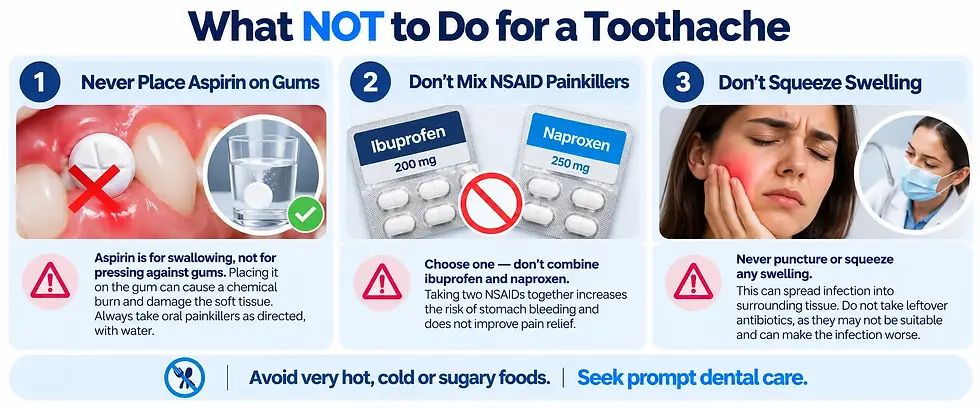
Do not squeeze or puncture any visible swelling, as this can spread infection into surrounding tissue. And do not take leftover antibiotics from a previous prescription. Antibiotics do not replace dental treatment; they are an adjunct to it, and using them unsupervised risks masking a worsening infection while antibiotic resistance builds.
Does it matter if you're pregnant, a child, or on blood thinners?
Safe tooth pain relief at home for children
Children must receive paracetamol or ibuprofen dosed strictly according to their weight, age, and the product's own instructions, using the measuring device provided. Ibuprofen is not suitable for infants under six months. Aspirin must never be given to children or teenagers with a febrile illness, due to the risk of Reye's syndrome. Benzocaine gels are not safe for children under two. All medicines should be supervised by an adult and stored securely out of reach.
Pregnancy, breastfeeding, and anticoagulant medications
Paracetamol is generally the preferred first-line option during pregnancy, used at the lowest effective dose for the shortest time. NSAIDs, including ibuprofen and naproxen, carry meaningful risks from 20 weeks onward and should not be taken without specific medical advice. If you are unsure, speak to your GP, midwife, or pharmacist before taking anything.
Both paracetamol and ibuprofen are generally compatible with breastfeeding at recommended doses, though it is worth confirming with a clinician if your infant is premature or medically fragile. Anyone taking warfarin or another anticoagulant should avoid NSAIDs and aspirin unless their prescriber has explicitly approved them, and should never alter their anticoagulation medication without medical advice. Paracetamol is often the safer alternative, but even repeated high doses can affect INR in warfarin users, so use the lowest effective dose.
What warning signs mean home treatment is not enough?
Signs that point to an abscess or spreading infection
A dental abscess has recognisable signs: throbbing pain accompanied by a visible gum pimple, pus or a foul taste in the mouth, a fever, swollen or tender lymph glands in the neck, increasing cheek or jaw swelling, and pain on biting. Any of these warrant same-day urgent dental contact. A dental abscess will not resolve on its own, and toothache first aid can only mask the symptoms while the infection worsens beneath the surface.

When to call 999 or go straight to A&E
Some situations go beyond urgent dental care entirely. If swelling is spreading into the neck or under the chin, breathing or swallowing has become difficult, the mouth cannot open properly, or the tongue appears pushed upward, these are signs of a potentially life-threatening spreading infection. Do not wait for a dental appointment and do not drive yourself if breathing is impaired. Call 999 or attend the nearest A&E immediately. A dentist is still needed afterwards to treat the source, but airway safety comes first.
Still hurting? Here's when to contact an emergency dentist
Every medicine and remedy in this article is a temporary bridge, not a solution. Decay, a cracked tooth, an abscess, or a failing filling all require professional assessment and treatment. Relying on home approaches for more than a day or two risks allowing a contained problem to develop into something far more complex and costly to treat.
At Wigmore Smiles & Aesthetics in Luton, we offer emergency dental appointments for patients in acute pain. Our team is experienced in assessing dental pain quickly, and we use modern technology including iTero 3D scanning to get a clear picture of what is happening beneath the surface. You do not have to manage this alone. Consultations for advertised services are available with a refundable £30 deposit; if you are experiencing an emergency, get in touch with our team as soon as possible to enquire about an urgent appointment and find out the next available slot.
Final thoughts
The most reliable toothache medicine at home remains ibuprofen or paracetamol for adult tooth pain; a saltwater rinse and cold compress are the safest supportive measures alongside them. Placing aspirin on the gum or combining two NSAIDs are risks to avoid outright. None of these approaches treats the cause of the pain, and none of them should be used as a reason to delay getting seen.
If you notice swelling spreading into the neck, difficulty breathing or swallowing, or any of the other warning signs covered above, call 999 or go to A&E without delay. These are medical emergencies that cannot wait for a dental appointment.
For everything else, including severe or persistent toothache, pain that is not controlled by OTC medicines, or any suspicion of an abscess, contact Wigmore Smiles & Aesthetics in Luton today and ask about an emergency dental appointment. Home remedies can make the wait more bearable, but proper dental care is what actually solves the problem


Comments