
I have lost my tooth now what should I do at this age

If you are dealing with missing teeth, you may already know that particular moment: you run your tongue along your teeth and feel a gap that was not there before, or you glance in the mirror and notice something is missing. Whether a tooth has been extracted, knocked out, or simply crumbled away over time, the reaction is almost always the same, a mix of concern, self-consciousness, and the nagging question of what you are actually supposed to do about it. If that sounds familiar, you are not alone. A 2018 dental practice survey in England found that 73% of adult dental attendees have at least one missing back tooth, yet many people delay seeking treatment for months or years.
At Wigmore Smiles & Aesthetics in Luton, tooth loss is one of the most common concerns we hear from new patients. The good news is that you have real options, and knowing what they are makes the whole situation far less daunting. This article covers what actually happens to your mouth when a missing tooth is left unreplaced, the three main ways to fill the gap, how dental implants compare to bridges and dentures, and what to expect when you sit down with a dentist to talk it through.
What missing teeth actually do to your mouth
The immediate effects you will notice
The first things people tend to notice are practical: chewing on one side becomes automatic, certain foods feel awkward or uncomfortable to eat, and speech can shift slightly, particularly when a front tooth is involved. Beyond the physical, there is an emotional dimension that patients describe very honestly. Many find themselves avoiding smiling in photos, covering their mouth when they laugh, and feeling self-conscious in meetings or on dates. These are not trivial concerns, and they matter just as much as any clinical risk factor. Confidence is closely tied to how your smile looks, and a gap in it can affect how you feel day to day.

Food also tends to collect in the empty space, making plaque control harder and creating persistent soreness around the site. The bite may feel different or unbalanced, which places extra load on the teeth that remain.
The longer-term changes that catch people off guard
What surprises most people is what happens beneath the surface over the months and years that follow. The moment a tooth root is gone, the jawbone beneath it no longer receives stimulation. Bone resorption begins almost immediately, with the most rapid shrinkage occurring in the first three to six months. Clinical studies report that up to 25 to 30 percent of ridge width can be lost within the first year alone, a figure that varies by site and individual but is well established in the implant literature. This is not just a structural concern; it changes the shape of your face over time, contributing to a slightly sunken or aged appearance around the jaw.
Meanwhile, the teeth on either side of the gap begin to drift and tip into the space. The tooth above or below can over-erupt, growing further out of the gumline than it should. Drifted teeth are harder to clean, raising the risk of decay and gum disease; in turn, that raises the risk of losing more teeth. This is the spiral that many patients do not anticipate. Leaving missing teeth unreplaced is not a neutral decision, it tends to create more problems than the original gap.
Missing teeth: the three main ways to fill the gap
Removable partial dentures
A partial denture is a removable plate, usually made from acrylic or a combination of acrylic and metal, that clips onto the remaining teeth to fill the gap. It is typically the least invasive starting point and the most affordable initial option. The plate is removed for cleaning and adjusted over time as the shape of your mouth gradually changes. For many patients, a well-made partial denture provides perfectly adequate function and appearance. The honest trade-off is that it is not fixed in place, which some people find less secure during eating, and it does require daily removal and cleaning as part of the routine.

Fixed bridges
A fixed bridge spans the gap by placing crowns on the teeth either side and suspending an artificial tooth, known as a pontic, between them. Because it is cemented in place, it feels closer to a natural tooth in everyday use: no removal, no clips, no plate sitting on the gum. The limitation is that the adjacent teeth need to be shaped down to accommodate the crowns, which involves removing healthy tooth structure. Cleaning beneath the bridge also requires a little extra effort using floss threaders or superfloss. A well-maintained bridge typically lasts 10 to 15 years before it needs to be replaced.

Dental implants
A dental implant replaces the tooth from the root up. A small titanium post is placed directly into the jawbone and, once it has integrated with the bone, a bespoke crown is fitted on top. The result closely replicates how a natural tooth looks, feels, and functions. Because implants work within the jawbone itself rather than relying on the teeth either side, they stand apart from bridges and dentures in several important ways, most notably in how they address the bone loss that other options do not.

Why dental implants stand apart as a long-term solution for missing teeth
How an implant actually replaces the tooth root
The dental implants in Luton process begins with a consultation and assessment to confirm suitability. If bone and gum health are adequate, a small titanium screw is placed into the jawbone during a minor surgical procedure carried out under local anaesthetic. Over the following three to six months, the bone gradually fuses around the implant in a process called osseointegration. Once that integration is complete and stable, a custom-made crown is attached on top. The key distinction from every other replacement option is that the implant functions within the jawbone itself, transmitting biting forces into the bone just as a natural root would.
The procedure is generally well tolerated. Patients who have been nervous about the idea often find, based on their own reported experience, that the process was more straightforward than they anticipated, and that discomfort in the days that followed was manageable with standard over-the-counter pain relief.
The bone preservation advantage
Because the implant stimulates the jawbone in the same way a natural root does, it actively helps to maintain the bone that would otherwise begin to shrink. This is the single most significant clinical advantage implants hold over bridges and dentures, both of which sit above the gumline and do nothing to address the bone loss occurring beneath. For younger and middle-aged patients in particular, preserving that bone over the long term has a meaningful impact on both oral health and facial structure.

The long-term survival data for implants is generally encouraging, though published figures do vary across meta-analyses and review populations. Systematic reviews broadly report single-tooth implant crown survival rates in the region of 94 to 97 percent at five years and around 89 to 95 percent at ten years. By comparison, conventional fixed bridges show survival rates of around 94 percent at five years and approximately 89 percent at ten years. Implants are one of the few dental restorations that, with routine oral hygiene and professional maintenance, can last for decades.
The treatment timeline: what to realistically expect
The full process, from consultation to fitted crown, typically takes between four and nine months depending on how quickly osseointegration occurs. This is longer than having a bridge fitted, and it is worth being upfront about that. The reason implant treatment takes time is precisely because the bone needs to form a stable bond with the titanium; rushing that stage compromises the result. Most patients find that framing this as an investment rather than an inconvenience makes the timeline feel much more manageable.
At Wigmore Smiles, we make the dental implant journey clear from the start, with personalised treatment planning and support at every stage. If you’re considering dental implants in Luton, book a consultation to explore your options.
Missing teeth: comparing your options side by side
Longevity, maintenance, and everyday experience
The practical differences between the three options become clear when you look at them over a ten or twenty-year horizon. Implants, maintained with normal brushing and flossing and regular professional check-ups, typically last decades. Bridges generally need replacing after ten to fifteen years, while partial dentures often require relining or remaking within five to ten years as the gum and bone change beneath them.
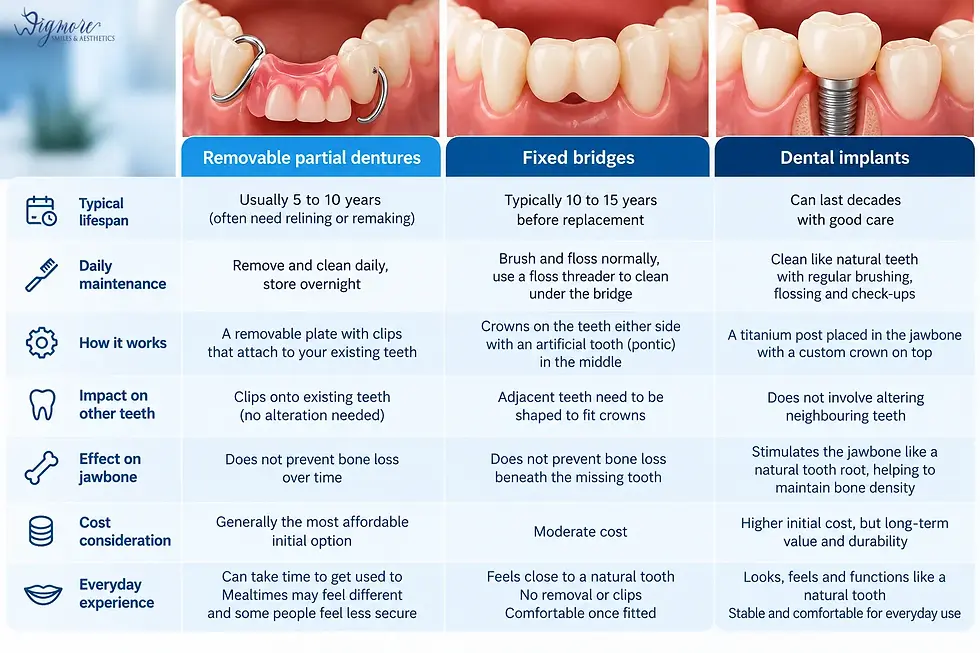
Day-to-day maintenance also differs. Implants are cleaned exactly like natural teeth, with no special technique required. Bridges need a floss threader to clean beneath the pontic, something most patients get used to quickly. Dentures are removed and cleaned separately each day and stored correctly overnight. No option is perfect, but the difference in long-term ease of maintenance is meaningful. If simplicity and longevity are your priorities, implants offer a clear advantage over the other two options.
Understanding the costs in the UK context
Cost is often the first question people ask, so it is worth being straightforward about the figures. In the UK, dental implants are almost always privately funded, with typical costs falling in the range of £1,800 to £3,500 per tooth. Fixed bridges and partial dentures are available on the NHS under the Band 3 charge, currently £332.10 in England for a course of treatment (as of 2026; check the NHS Business Services Authority for the most up-to-date figure). Privately, bridges typically cost between £400 and £2,500, and partial dentures between £400 and £1,200.
The upfront cost of implants can feel significant, and it is one of the most common reasons people lean toward a bridge or denture instead. At Wigmore Smiles & Aesthetics, we offer 0% finance options that spread the cost of implant treatment into manageable monthly payments, making the option far more accessible without requiring a large sum upfront. A consultation is the right place to get a personalised quote based on your specific situation.
What determines the right choice for you
Clinical factors that shape the decision
Bone volume is the most critical clinical factor for implants. A titanium post needs sufficient depth and width of bone to integrate securely. Where bone has already been lost, a bone grafting procedure may be an option, though it adds time and cost to the treatment journey. Where significant bone loss has occurred and grafting is not feasible, a bridge or denture may be the more appropriate choice.
Gum health matters for all replacement options, but it is especially important before implant treatment begins. Active periodontal disease must be brought under control first, because placing an implant into an unhealthy oral environment significantly raises the risk of failure.
Certain medical conditions also influence suitability and should be assessed carefully, including: uncontrolled diabetes; bisphosphonate therapy (particularly intravenous bisphosphonates); prior radiation to the jaw; significant immunosuppression; and recent cardiovascular events. These factors may shift the recommendation away from implants in some cases, based on established clinical guidance. Smoking is one of the most consistently reported modifiable risk factors for implant failure, with heavier smokers seeing meaningfully worse outcomes, a frank conversation well worth having with your dentist before treatment begins.
Lifestyle and budget as real factors
Even where implants are clinically the best option for missing teeth, personal circumstances shape the final decision. Budget, treatment timeline, and individual priorities are all legitimate parts of the conversation. A partial denture can be a genuinely good short-term solution while someone saves toward an implant, or a completely appropriate long-term choice for someone who is not a surgical candidate. There is no single right answer that applies to everyone, and a good clinician will not present it that way. The right recommendation comes from knowing your mouth, your health history, and what matters most to you in daily life.
What to expect when you book a consultation
What gets assessed at your first appointment
A thorough missing teeth consultation involves a clinical examination of the gap and surrounding teeth, X-rays to assess the bone levels beneath the gum, and in many cases a 3D digital scan. At Wigmore Smiles & Aesthetics, the team uses iTero 3D digital scanning to get a precise picture of the bone structure, the position of neighbouring teeth, and the bite as a whole. This removes guesswork from the planning process and means that any treatment recommendation is grounded in what is actually there, not estimates.

The consultation is also a conversation, not just a clinical examination. It is an opportunity to talk through your lifestyle, what you find most important in a replacement, any concerns you have about treatment, and what your budget looks like. Patients who arrive with a clear sense of their priorities tend to leave with a plan that genuinely suits them.
Questions worth asking your dentist
Going into an appointment with a few specific questions helps you make the most of the time and leaves you feeling confident about the path forward. These are worth raising directly:
Which replacement option suits my bone levels right now?
How long is the treatment process for each option?
What are the costs, and do you offer payment plans?
What happens to my other teeth if I leave the gap untreated?
No question is too basic. A clinician who takes the time to answer clearly is one you can trust with your treatment. The team at Wigmore Smiles & Aesthetics in Luton genuinely welcomes these conversations, including from patients who have felt anxious about the dentist or who have not had a check-up for some time.
Missing teeth are a solvable problem
A gap in your smile feels significant because it is. It affects how you eat, how you speak, and how you feel about yourself, and over time it affects the health of the teeth and bone around it. Tooth loss, whether a single missing tooth or several, is a problem with clear, well-established solutions. Whether a partial denture, a fixed bridge, or a dental implant turns out to be right for you depends on your bone health, gum health, lifestyle, and budget. There is no universal answer, only the right answer for your specific mouth and circumstances.
What matters most is acting sooner rather than later. The longer a gap is left, the more bone is lost and the more teeth can drift, which gradually narrows the options available. Getting an assessment early keeps more doors open and gives you a clear, personalised picture of what is possible.
If you are ready to find out what the right option looks like for you, get in touch with the team at Wigmore Smiles & Aesthetics in Luton to book a missing teeth consultation. We offer flexible 0% finance to make treatment accessible, evening appointments for those who need them, and a welcoming environment for anyone who has been putting this off for a while. A single dental implant appointment in Luton can give you the clarity you need to move forward with confidence.


Comments